Part 1: Power & Memory
This essay begins with a thorough examination of the relationship between power and memory. History is not merely a record of events; it reflects the authority of those who determine what is preserved, emphasized, or obscured. By interrogating how narratives are constructed and institutionalized, this series explores who controls the stories of the past — and how that control shapes the present.
Power, Progress & The American Present
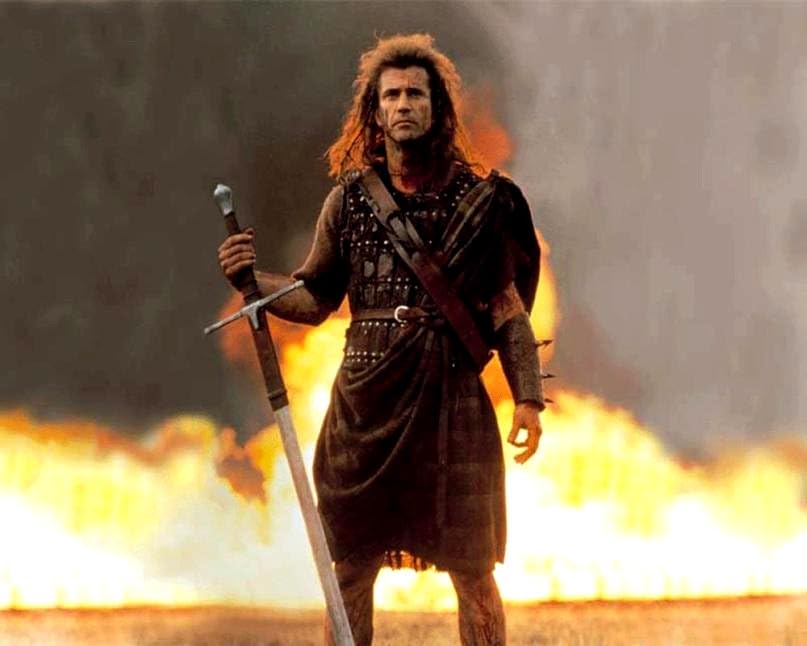
The 1995 movie Braveheart opens not with a bloody battle, but with a stern warning to posterity.
The film features panoramic views of the Scottish Highlands, a vast, rugged land shrouded in mist and bathed in the natural glow of the sun. The formidable landscape is composed of rolling hills, deep valleys, and distant mountains, painted in muted earth tones — pale grays, dark greens, and weathered browns — blended to capture the beauty and harshness of the terrain.
As the camera glides over the Highlands, the film’s score unleashes a slow, haunting melody that immediately draws the viewer into the emotional tenor of the story to come. Traditional Celtic instruments, such as the low whistles and the uilleann pipes, carry the tune with a mournful grace. The music captures the sorrow of Scotland’s long history of struggles, while also echoing the strength, courage, and resilience of its spirit. A subtle string section gradually weaves in, adding emotional depth with soft, swelling tones that seem to rise and fall with the contours of the hills.
The narrator’s voice breaks through, grounding the story not in legend but in recollection shaped by conflict. The voice belongs to Robert the Bruce, speaking from the vantage point of survival rather than a position of triumph.
“I shall tell you of William Wallace. Historians from England will say I am a liar, but history is written by those who have hanged heroes,” he says.
The line is often simplified or misremembered, but its meaning is sharper than the familiar refrain that history is written by the winners. It suggests something more unsettling: power does not merely defeat its enemies; it redefines them. Acts of resistance become transgressions. Rebels are recast as traitors. Heroes are preserved only as villains in the pages of history books.
Another way of expressing this idea — one frequently invoked in popular discourse — is the claim that “history is written by the victors,” a phrase often and incorrectly attributed to Winston Churchill. There is no reliable evidence that Churchill ever said it. Like many historical aphorisms, it has been retroactively assigned authority through repetition rather than documentation. A statement about history, confidently repeated and rarely challenged, turns out to be historically inaccurate in its attribution. In this sense, the phrase performs the illusion it seeks to describe.
Yet even the victors’ version of history is incomplete. Victors do not simply record events; they define legitimacy. They determine which deaths are remembered as noble sacrifices and which are condemned as justifiable executions. They determine whether violence is framed as justice or a necessity. They determine whether dissent is remembered as an act of courage or cast as an act of cowardice. This is the tension Braveheart announces from its opening moments.
This excerpt is from our inaugural essay for Remnants, an online project that investigates how power, history, and memory shape the American present. Read the complete essay on Substack at this link.
 Cindy Santos